
Reviewed · HISTORICAL TOURS
Walking tour of Tirana; History & Culture
Tirana tells its story in layers. This two to three-hour walk connects communist memorials, Ottoman landmarks, religious buildings, and modern city life in a compact introduction to Albania’s capital. I like the small maximum group of eight, which should make it easier to ask questions, and I like the way the route moves beyond postcard sights into places tied to Enver Hoxha’s rule and Albania’s uneasy past.
The $17.97 price is fair for a guided city introduction, especially with a local companion leading the way. The main consideration is pace: the tour covers many stops, but some visits last only 10 or 15 minutes, and admission to the House of Leaves, Clock Tower, and Orthodox Cathedral is not included.
In This Review
- Key points before you book
- Starting at the Twin Towers
- Postbllok and the memory of isolation
- Blloku, from forbidden quarter to cafe district
- Enver Hoxha’s former residence
- Tirana’s religious mix in three city landmarks
- House of Leaves and the secret police
- Skanderbeg Square and the heart of the capital
- The Clock Tower and Et’hem Bey Mosque
- Tirana Castle and modern city life
- Pyramid of Tirana and Rinia Park
- How much value do you get for $17.97?
- Who will get the most from this walk?
- Booking details worth knowing
- Should you book the Tirana walking tour?
- FAQ
- How long does the Tirana walking tour last?
- What language is the tour offered in?
- How large is the tour group?
- Are entrance tickets included?
- Where does the tour begin?
- Can I cancel for a full refund?
Key points before you book
- Communist-era Tirana takes center stage: Postbllok, the former political elite’s neighborhood, and Enver Hoxha’s residence add serious historical context.
- The group is capped at eight people: That is a useful size for questions and conversation without turning the walk into a parade.
- The route covers major central sights: You see Skanderbeg Square, Et’hem Bey Mosque, the Clock Tower, Tirana Castle, the Pyramid, and Rinia Park.
- Guides make the difference: Angelo, Markel, and Gjergj received especially warm praise for clear explanations, patience, and personal insight.
- Expect a walking overview, not full museum visits: Several locations are viewed from outside or visited briefly, with entry fees extra.
- The tour is offered in English: One guide, Gjergj, also handled French and English during the same outing.
Starting at the Twin Towers
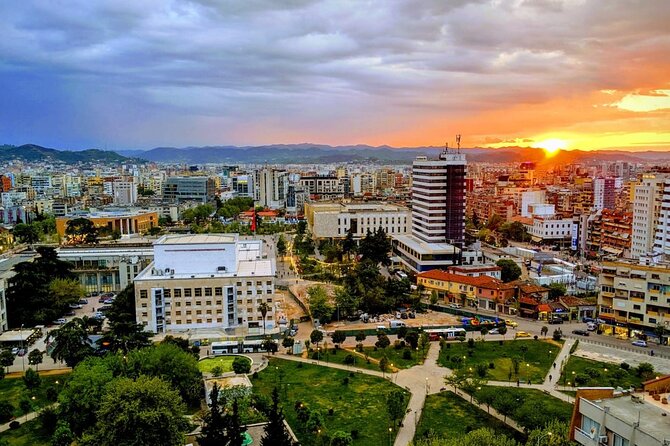
The walk begins at the Choose Balkans office on the third floor of Tower 2 at the Twin Towers on Bulevardi Dëshmorët e Kombit. This is a central and easy-to-identify starting point, but you should allow time to find the office inside the building rather than arriving at the last second.
Your local companion sets the tone for the day. The strongest feedback points to guides who explain Albania in a personal, conversational way rather than simply reciting dates. Markel is praised for patience and for sharing family and personal insight into life during and after communism. Angelo is described as friendly and well informed, while Gjergj impressed with his language skills and ability to explain complex subjects clearly in both French and English.
That matters in Tirana. The city’s story is not just Ottoman, communist, and modern. It is also about how ordinary families lived through strict state control, how religion was treated under Enver Hoxha, and how quickly the capital has changed since the end of communism.
More Walking Tours in Tirana
- Walking Tour of Tirana
★ 5.0 · 646 reviews - Tirana: Express Walking Tour with a Guide
★ 4.8 · 503 reviews - Tirana Center: Magic Walking Tour French/Italian/English Etc
★ 4.9 · 402 reviews
Postbllok and the memory of isolation
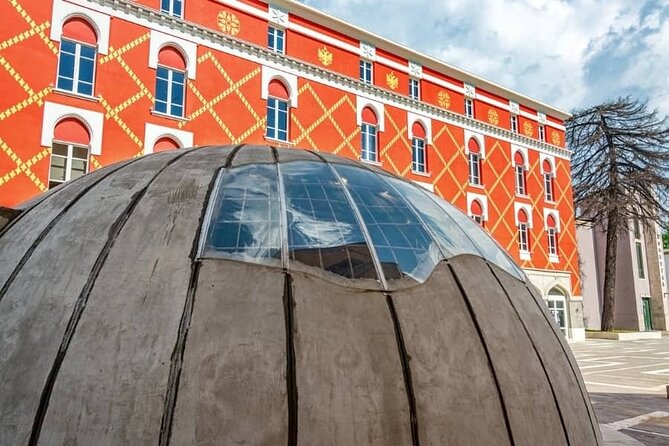
The first substantial stop is Postbllok, also called the Checkpoint Monument. It sits on the main boulevard opposite the government building and honors political prisoners who suffered under Albania’s communist regime.
Plan on about 30 minutes here, making it one of the most important stops on the route. The memorial is a strong opening because it gives the rest of the walk a serious frame. You are not simply seeing attractive squares and old mosques. You are learning why Tirana can feel both open and guarded, modern and marked by the past.
This is the place to ask questions. The guide can connect the memorial to Albania’s long period of isolation and to the broader communist system that shaped daily life. The walk does not present the past as a museum piece. It links it to the city you see around you today.
Blloku, from forbidden quarter to cafe district
From Postbllok, the group heads into Blloku. Under communism, this area was reserved for members of the Albanian political elite. Ordinary citizens could not simply wander through it.
Today, Blloku is filled with cafes, boutiques, and colorful street art. The change is striking, and the short 10-minute stop works best as a contrast with Postbllok. One moment you are discussing political prisoners and state control. Soon after, you are in an area associated with nightlife, shopping, and modern city culture.
Do not expect a long break for coffee here. Blloku is mainly a quick walk and explanation, not a dedicated food or shopping stop. If you want to return later for a meal or drink, make a note of the streets as you pass through.
Enver Hoxha’s former residence
The tour also passes the residence of Albania’s communist leader, Enver Hoxha. The stop lasts around 10 minutes, so you should think of it as a historical viewing point rather than a house tour.
Its value comes from the guide’s explanation. The building is tied directly to the political system discussed at Postbllok, and seeing it within Blloku helps you understand the physical separation between the ruling elite and the rest of society.
This is one of the moments when a local guide adds real value. Without context, the residence may look like another city building. With a clear explanation, it becomes part of the story of privilege, secrecy, and control.
More History Tours in Tirana:
- From Tirana: Durres History Trip with Beach or Promenade
★ 4.8 · 455 reviews - Guided tour in Tirana – discoveries, history, culture (in FRENCH)
★ 5.0 · 204 reviews - From Tirana: Durres city & Golem beach, Sun & History Day Trip
★ 5.0 · 134 reviews - Tirana Walking Tour: History, Culture &Gems by a Passionate Guide
★ 5.0 · 52 reviews
Tirana’s religious mix in three city landmarks
The route then turns toward the Resurrection of Christ Orthodox Cathedral. About 15 minutes are allowed here, and admission is not included.
The cathedral is important not only for its architecture but also for the religious picture it helps create. Albania includes Sunni Muslims, Bektashi Muslims, Orthodox Christians, and Catholics. The tour uses the city center to explain how these communities fit into Albania’s past and present.
You also visit or pass the Et’hem Bey Mosque, the Catholic St. Paul’s Cathedral, and the large Namazgah Mosque. The itinerary describes Namazgah as the largest mosque in the Balkans. Taken together, these sites show how many faith traditions are represented within a relatively compact central area.
The religious stops are brief. If you want detailed architectural study or quiet time inside each building, this tour may move too quickly for you. If you want a clear introduction to Albania’s religious balance, the sequence is effective.
House of Leaves and the secret police
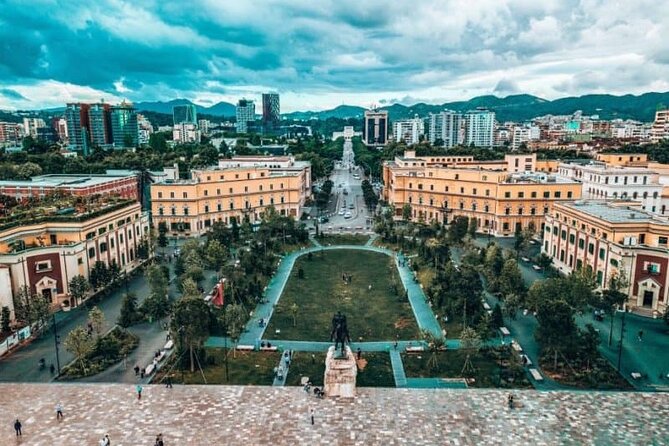
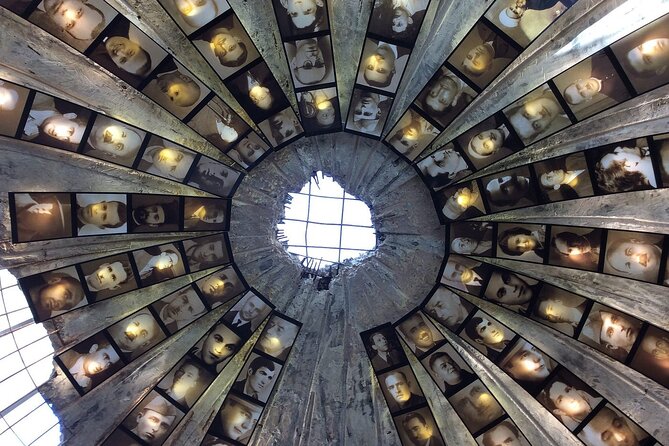
The Museum of Secret Surveillance, known as the House of Leaves, is one of the most revealing stops. It is located in a building associated with secret surveillance during the communist period.
The planned visit lasts about 15 minutes, and admission is not included in the tour price. That short window means you should not expect to see the full museum at length. Instead, the guide introduces the site and explains why it matters.
For many people, this will be one of the most memorable locations on the walk. Postbllok shows the human cost of political repression. The House of Leaves helps explain the machinery behind it, including surveillance and fear. If this subject interests you, consider returning independently after the tour for a longer visit.
Skanderbeg Square and the heart of the capital
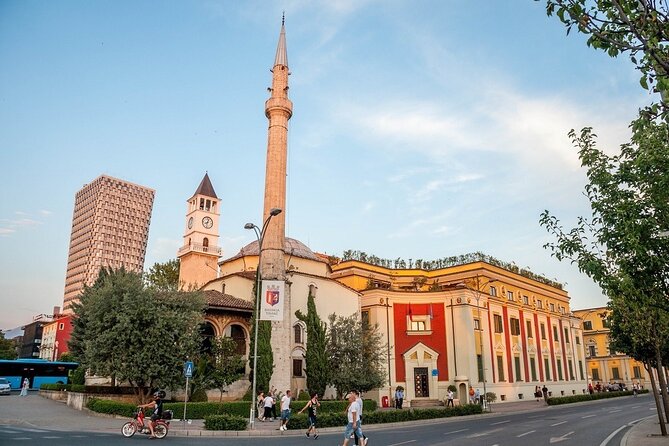
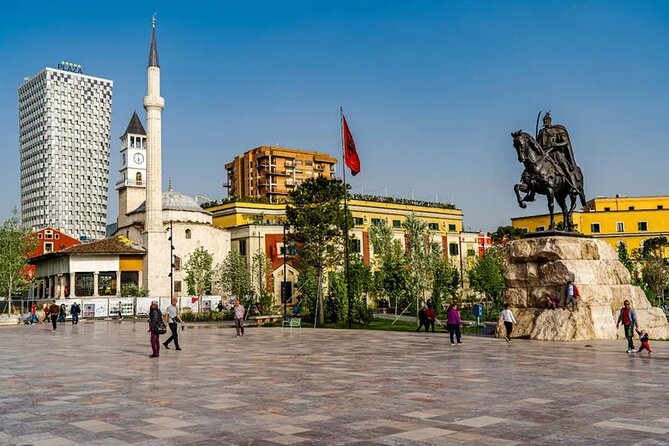
The walk continues to Skanderbeg Square, Tirana’s main public space. It is named for Gjergj Kastrioti Skënderbeu, Albania’s national hero.
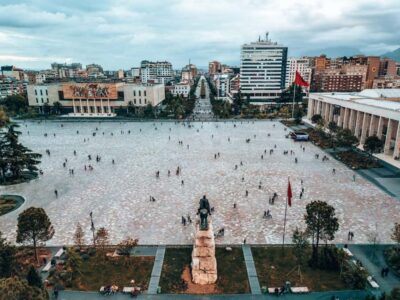
The square is surrounded by several major landmarks, including the National Museum, Bank of Albania, Opera Theatre, Skanderbeg’s statue, and Et’hem Bey Mosque. You get around 15 minutes here, enough for orientation and photographs, though not enough for a full visit to the surrounding institutions.
This is a useful point in the walk because it brings together several eras. Ottoman influence appears in the mosque. National identity appears in the statue. State and civic life appear in the museum, bank, and theatre. The guide can help you see the square as more than an open plaza.
The city center can feel energetic, and the square is a good place to notice Tirana’s mix of formal public buildings and casual street life. Keep your attention on the guide, since the itinerary moves steadily from one landmark to the next.
The Clock Tower and Et’hem Bey Mosque
Near Skanderbeg Square, the Clock Tower offers another brief stop of about 15 minutes. Admission is not included, so the tour price covers the guided walk, not every optional entrance.
The tower is one of the recognizable symbols of central Tirana. It pairs naturally with Et’hem Bey Mosque, which is included as a free stop on the route. The mosque adds Ottoman-era context and helps explain the long presence of Islam in Albanian public life.
You should confirm on the day whether the group is entering the mosque or viewing it as part of the outside explanation. The supplied details list admission as free, but the exact amount of interior time can depend on the guide, opening conditions, and the pace of the group.
Modest dress is a sensible choice for any visit to a religious site. The tour is designed for a broad audience, so respectful behavior is expected even when the stop is short.
Tirana Castle and modern city life
Tirana Castle is not a traditional castle visit in the usual sense. The central site now functions as a pedestrian street where older traditions meet modern shops and dining spaces.
The tour allows about 15 minutes. That is enough to walk through and understand the area, but not enough for a leisurely meal. Lunch, drinks, and snacks are not included, so carry water and plan food separately if you need it during the walk.
I like this stop because it keeps the tour from becoming too solemn. After communist memorials, surveillance history, and religious landmarks, Tirana Castle shows the city using its past in a modern setting. You get a taste of how the capital’s old center is being adapted for present-day life.
Pyramid of Tirana and Rinia Park
The listed route finishes with the Pyramid of Tirana and Rinia Park. The Pyramid stop lasts about 10 minutes, followed by roughly 10 minutes in the park.
The Pyramid is closely tied to Albania’s communist period and has become one of the city’s most recognizable modern structures. Even a short stop gives the guide a chance to explain its place in Tirana’s changing identity.
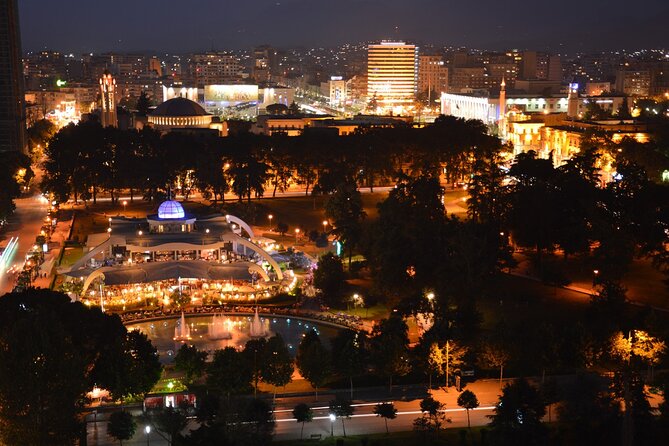
Rinia Park offers a lighter final note. It is a public green space in the middle of the capital and helps round out the tour with a look at everyday urban life.
There is one practical detail to clarify before setting out. The route description names the Pyramid and Rinia Park as the final sights, while the meeting information says the activity ends back at the original office. Ask the guide which point will be the actual finish that day. This matters if you have a lunch booking, museum reservation, or onward transport.
How much value do you get for $17.97?
At $17.97 per person, this is an inexpensive way to get a guided introduction to Tirana. The price is especially reasonable with a maximum of eight people, since a smaller group usually gives you more room to ask about family life, politics, religion, and present-day Albania.
You are paying mainly for interpretation, not entrance tickets. The House of Leaves, Clock Tower, and Orthodox Cathedral list admission as extra, while lunch, drinks, snacks, souvenirs, and personal spending are also outside the price.
That setup suits you if you want a strong first orientation and plan to choose later which museums deserve more time. It is less suitable if you want every major building opened and explored during one outing.
The tour is usually two to three hours, though one account describes completing it in about two hours, which worked well in hot weather. That is useful advice. Tirana’s central sights are close enough for a compact walk, but heat can make a long outdoor tour tiring. An early start or cooler part of the day would be the sensible choice, though no specific departure time is provided here.
Who will get the most from this walk?
I would recommend this tour to a first-time visitor who wants context before exploring Tirana alone. It suits history-minded visitors, people curious about Albania’s communist past, and anyone who wants to understand the city’s religious mix without arranging several separate visits.
It is also a good fit for couples, families with older children, and small groups who prefer conversation over a large coach outing. The limited group size and English-language format make it easier to follow the explanations and ask questions.
You may want a different plan if your priority is food. The tour passes areas with cafes and dining, but it does not include tastings, lunch, or drinks. You may also want a museum-focused guide if the House of Leaves or the National Museum is your main goal.
The strongest element is the guide. Markel’s patience, Angelo’s clear historical explanations, and Gjergj’s ability to handle more than one language all point to a tour where the person leading it shapes the experience. Ask questions, especially about the communist period and everyday Albanian life. That is where this walk offers more than a standard checklist.
Booking details worth knowing
The tour is offered in English and confirms your booking at the time of purchase. Most people can take part, and group discounts are available.
Free cancellation is allowed up to 24 hours before the start time for a full refund. Changes or cancellations made less than 24 hours before the start time are not accepted for a refund, with cut-off times based on Tirana’s local time.
Tips are not required in Albania or the Balkans, but the operator recommends tipping for good service as an international custom. If your guide gives thoughtful explanations, waits patiently, or adapts well to questions and language needs, a tip is a reasonable way to show appreciation.
Should you book the Tirana walking tour?
Book it if you want a compact, low-cost introduction to Tirana with a strong focus on communism, religion, and the city’s main central sights. The route is broad, the price is modest, and a small group gives the guide room to make the walk personal.
Skip it if you want long interior visits, a food experience, or a relaxed photography walk. For most first visits, though, this tour gives you the background needed to make sense of Tirana. I would book it near the start of a stay, then return on your own to the House of Leaves, Clock Tower, religious buildings, or Blloku for more time.
FAQ
How long does the Tirana walking tour last?
The tour lasts approximately two to three hours. One account describes completing it in about two hours, which was considered a comfortable length in hot weather.
What language is the tour offered in?
The tour is offered in English. A guide named Gjergj has also led a group in both French and English.
How large is the tour group?
The maximum group size is eight people.
Are entrance tickets included?
Admission is not included for the Resurrection of Christ Orthodox Cathedral, the House of Leaves Museum of Secret Surveillance, or the Clock Tower. Other listed stops show free admission.
Where does the tour begin?
The meeting point is the Choose Balkans office on the third floor of Tower 2 at the Twin Towers, Bulevardi Dëshmorët e Kombit, Tirana.
Can I cancel for a full refund?
Yes. You must cancel at least 24 hours before the experience start time to receive a full refund. Changes or cancellations made less than 24 hours before the start time are not accepted for a refund.
Newly listed around Tirana
- Wonderful Sunset and Dinner in the Castel Of Petrela★ 4.6 · 4 reviews
- Zipline Tirana Adventure & Petrela Castle – With Transport★ 4.4 · 10 reviews
- Wine Tasting & Vineyards Escape near Tirana★ 4.9 · 8 reviews
- Walking Tour in Tirana, Albania★ 3.7 · 28 reviews
- Vlora, Dhermi & Llogara Day Trip from Durrës or Golem★ 5.0 · 5 reviews
- Day Tour to Petrela Castle and Zip Line Albania Adventure★ 5.0 · 10 reviews
- From Tirana: Mount Dajti Adventure, Local Vibes & Cable Car opt★ 4.5 · 6 reviews
- Winetasting tour in Alpeta winery – Roshnik village by 1001 Albanian Adventures★ 5.0 · 26 reviews
Historical Tours, compared.
Guided tour in Tirana – discoveries, history, culture (in FRENCH)
Read our review →
Durres city & Golem beach, Sun & History Day Trip
Read our review →
Tirana Walking Tour: History, Culture &Gems by a Passionate Guide
Read our review →
Semi – Private Tour at Cape of Rodon; Hidden Beaches & History
Read our review →
Ancient City of Butrint, UNESCO World Heritage site – A Must
Read our review →
Browse the lists this tour appears in