
Reviewed · WALKING TOURS
Tirana Walking Tour
Tirana reveals itself on foot. This three-hour walk links Ottoman landmarks, communist symbols, and modern city life in one sensible route. I like the small-group limit of 15, and I like that the guide does more than point at buildings: Aldo, one of the guides, adjusts the pace, answers questions fully, and adds restaurant and sightseeing advice. The only drawback is that much of the tour happens outdoors, so poor weather can affect the schedule.
I also appreciate the price, $11.91 per person, which is modest for a licensed guide and three hours of walking. The tour offers a useful first look at Tirana, but it is more an orientation than a series of museum visits. Admission to the listed stops is free, while paid entry, food, coffee, and other personal costs are not included.
In This Review
- Six details that make this Tirana walk useful
- Why this three-hour route works as a first look at Tirana
- Skanderbeg Square brings old Tirana into focus
- Rruga Murat Toptani shifts from monuments to memory
- Bulevardi Dëshmorët e Kombit follows Tirana’s political spine
- Blloku shows how quickly a district can change
- What the guide adds beyond a map
- Is $11.91 good value for three hours?
- Practical planning for the walk
- Who will get the most from this Tirana tour?
- Should you book the Tirana Walking Tour?
- FAQ
- How long does the Tirana Walking Tour last?
- Where does the tour begin?
- Where does the tour end?
- Is admission to the listed sights included?
- Is the tour offered in English?
- How many people can join the tour?
- Can I cancel for a full refund?
Six details that make this Tirana walk useful
- Skanderbeg Square begins the story: See Et’hem Bey Mosque, the Clock Tower, the National Museum, Hotel Tirana, and other central buildings in one compact opening stop.
- Communist Albania gets serious attention: Bunk Art 2, the Pyramid, Hoxha’s former home, and the central government district give the tour real historical weight.
- Blloku shows a sharp change in daily life: The former restricted district of communist leaders is now one of Tirana’s most active areas.
- The guide shapes the pace: Aldo is praised for assessing what you already know, slowing down when needed, and explaining the missing pieces.
- The group is capped at 15 people: That is small enough for questions without promising a private tour.
- The route returns to the starting point: You begin and finish at Sheshi Skënderbej 1, making the tour easy to fit into a first day in the city.
Why this three-hour route works as a first look at Tirana
Tirana can feel like several cities placed side by side. Ottoman-era traces, state buildings from the twentieth century, communist monuments, new construction, and cafe life all appear within a relatively compact central area. A walking tour helps you connect those pieces instead of seeing each building as an isolated photo stop.
The route is also well arranged for a first day. It begins at Skanderbeg Square, moves along Rruga Murat Toptani and the main boulevard, then finishes in Blloku. That order moves from the city’s older central symbols toward its political heart and then into the district that best captures Tirana’s modern social life.
You should expect a guided walk, not a museum-heavy outing. The listed stops have no admission charge, and the guide’s main role is to explain what you are seeing. If you want to enter Bunk Art 2 or another attraction, you should treat that as separate from the scheduled walk.
The group limit of 15 matters. A large city walk can turn into a flag-following exercise, but this cap gives you a better chance to hear the guide and ask about Albania’s past. It is still a group tour, so the exact feel depends on the day’s participants and the guide leading it.
More Walking Tours in Tirana
- Walking Tour of Tirana
★ 5.0 · 646 reviews - Tirana: Express Walking Tour with a Guide
★ 4.8 · 503 reviews - Tirana Center: Magic Walking Tour French/Italian/English Etc
★ 4.9 · 402 reviews
Skanderbeg Square brings old Tirana into focus
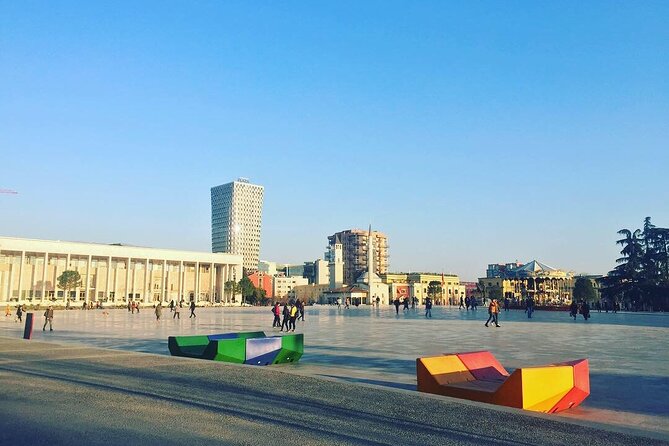
The tour starts at Sheshi Skënderbej 1, the central meeting point in Tirana. The first half hour concentrates on the buildings around Skanderbeg Square, giving you a quick introduction to the city’s older public center.
The Et’hem Bey Mosque is the key stop. It is described as the oldest building in Tirana and one of the city’s main symbols. The tour explains its past and draws attention to its decorative details, which makes this more useful than simply walking past the entrance and taking a photograph.
Nearby, the Clock Tower provides another easy landmark to understand. It was once Tirana’s tallest building and remains one of the clearest reminders of the older city. The mosque and tower work well together because they show two different sides of the historic center: religious architecture and civic utility.
The guide also points out the National Bank of Albania, the National Museum, Hotel Tirana, the Palace of Culture, and Tirana Municipality. You will not get a full museum visit at each one, but you will learn how these buildings fit into the square and the city’s public life.
I like this opening because it gives you names and reference points you can use for the rest of your stay. After the tour, you can return to the square on your own and know what you are looking at. The limitation is time. Thirty minutes goes quickly, so expect an overview rather than a long architectural study.
Rruga Murat Toptani shifts from monuments to memory
The next section takes about an hour along Rruga Murat Toptani. This part moves from the central square into places that help explain Albania’s communist period and the political changes that followed.
Bunk Art 2 is one of the most important landmarks on this stretch. The museum deals with communist atrocities, so the subject is difficult but necessary. The tour passes by it and explains its place in Tirana. Admission is not included, and the schedule does not present it as a full indoor visit, so you should plan a separate visit if you want to see the exhibits.
The route also passes the Castle of Toptani and the former residence of Prince Zogu. These stops add an earlier political layer before the route turns toward more recent state institutions. The contrast is useful: Albania’s royal and pre-communist past sits close to the buildings and symbols of the later regime.
You will also pass the House of Parliament and the new mosque, described as the largest in the Balkans and still under construction at the time of the tour information. That combination gives this section a clear theme: Tirana is still changing, and new religious and civic buildings continue to reshape the center.
This is where a good guide makes a real difference. The buildings are not difficult to see, but their relationship to Albania’s political story is less obvious. Aldo is praised for connecting the missing parts of that story, and for answering questions rather than rushing from one stop to the next.
The walk is long enough to give this section weight, but you should wear comfortable shoes. The tour lasts roughly three hours overall, and the route includes a full hour here followed by another hour on the main boulevard.
Bulevardi Dëshmorët e Kombit follows Tirana’s political spine
The longest and most serious section is the one-hour walk along Bulevardi Dëshmorët e Kombit, Tirana’s main boulevard. Here, the focus turns toward national government, education, public ceremony, and the symbols of the communist state.
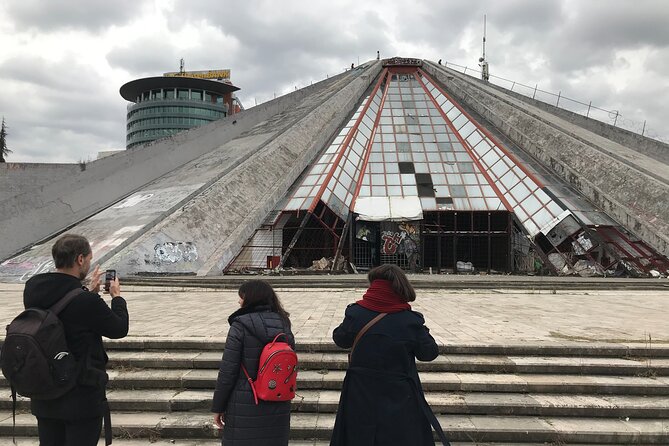
The Pyramid is a major stop. It was built as a museum connected with dictator Enver Hoxha after his death, and its presence raises questions about how Tirana handles the physical remains of that period. The tour uses it as part of the wider story rather than treating it as just an unusual building.
Along the boulevard, you pass the Prime Ministry, Presidency, Parliament offices, University, Academy of Arts, and National Stadium. These are not separate museum visits, but together they show how much political and institutional life is concentrated along this route.
I value this part because it gives you a sense of scale and order. You are not only hearing about leaders and governments. You are walking through the spaces built to represent the state, then comparing those spaces with the city’s newer public life.
The guide’s role is especially important here. A list of ministries, offices, and official buildings can become dry. The strongest feedback about this tour focuses on passion, clarity, and the way the guide adjusts explanations to the group’s existing understanding. That is the difference between learning a few names and gaining a usable picture of Albania’s modern past.
The boulevard section may be less appealing if you want constant visual variety or indoor attractions. It is a substantial outdoor walk, and some stops are best understood through explanation rather than close viewing. Still, it is a strong choice if you want political context instead of a quick collection of postcard sights.
Somewhere else in Albania, a completely different day:
- From Tirana: Bovilla Lake & Gamti Mountain Hiking Day Trip
★ 4.9 · 4,397 reviews - From Tirana: Bovilla Lake & Gamti Mountain Hiking Tour
★ 4.9 · 3,003 reviews - From Tirana: Bovilla Lake & Gamti Mountain Viewpoint Hike
★ 4.8 · 2,053 reviews - Tirana/Durres/Golem: Saranda, Ksamil, Blue Eye Day Trip
★ 4.8 · 1,584 reviews
Blloku shows how quickly a district can change
The final half hour takes you into Blloku, once the private residential area of communist leaders. Ordinary citizens were not allowed to enter the district during that period, which gives the neighborhood unusual symbolic weight.
The tour passes by Hoxha’s house, where he lived during his rule of communist Albania. Seeing the former residence in its neighborhood setting helps make the old system more concrete. The point is not only that a leader lived there, but that the district was separated from normal public life.
Blloku has since become one of the most active and impressive places in Tirana. That change gives the walk a strong ending. You begin with old religious and civic landmarks, move through state and communist symbols, and finish in a district now associated with social life and the city’s present direction.
The tour does not promise a meal, a bar stop, or an extended nightlife visit. Its job is to explain what Blloku meant before and what it represents now. You can use that introduction to return later if you want more time in the area.
One useful detail from the guide feedback is that the walk may include a short coffee break. It is not listed as an included feature, so you should not assume your drink is covered. Still, the possibility of a relaxed pause fits the overall approach described by the strongest comments: a slow walk, clear explanations, and room for questions.
What the guide adds beyond a map
A licensed guide is included, and the guide quality appears to be the main reason to book this tour instead of walking the route alone. Aldo is described as punctual, prepared, and able to judge how much the group already knows about Albania.
That matters in Tirana because the city’s story can be hard to place without local context. You may recognize a mosque, a government building, or a communist-era monument, but still miss why it matters. The guide fills those gaps and links older Tirana with the modern city.
Aldo also provides suggestions for other places to visit and restaurant recommendations. Those tips can be especially helpful at the start of an Albania trip, when you are still deciding how to use your time. The tour’s strongest praise also points to the guide’s passion and an easy-to-follow way of speaking.
The experience is offered in English. If you have little background on Albania, the guide can give you a basic framework. If you already know the country’s story, you can use the walk to ask more specific questions and compare your understanding with local explanations.
Because the guide may adapt the pace, the walk is not locked into a single rigid rhythm. That is a plus for many people. It also means the exact amount of detail can vary by group and guide, so you should think of the published timing as approximate.
Is $11.91 good value for three hours?
At $11.91 per person, the tour is inexpensive for a three-hour guided introduction to central Tirana. The value comes from the route and the interpretation, not from included admissions or extras.
You are paying for a licensed guide who covers four connected areas and explains the city’s Ottoman, royal, communist, and present-day chapters. If you tried to research every building around the square and boulevard yourself, you could easily spend more than the tour price in time and effort.
The price is also helped by the small group cap of 15. It is not private guiding, but it should provide a better listening experience than a large group. Group discounts are available, which may improve the value if you are booking for several people.
Keep your expectations clear. Food, drinks, museum entry, and anything else not listed as included are your responsibility. The tour is best viewed as a low-cost orientation that helps you choose what deserves a longer visit later.
Practical planning for the walk
The meeting point is Sheshi Skënderbej 1 in Tirana, and the activity ends back at that same meeting point. That makes it convenient for a first morning or afternoon, especially if you want to continue exploring the center afterward.
Confirmation is provided at booking. The tour is near public transportation, and service animals are allowed. Most people can take part, but you should remember that this is a three-hour walking route with extended outdoor sections.
The experience is offered in English and allows a maximum of 15 participants. It is often reserved around 56 days ahead, so booking early is sensible if your dates are fixed. That timing is not a guarantee of availability, but it suggests the tour can fill well before arrival.
Free cancellation is available if you cancel at least 24 hours before the start time. Changes or cancellations made inside that window are not refunded or accepted. The tour needs good weather and a minimum number of participants. If poor weather or low enrollment causes cancellation, you are offered another date or experience, or a full refund.
Who will get the most from this Tirana tour?
I would choose this walk for a first visit to Tirana, especially if you want context before exploring Albania more widely. It suits people who enjoy city streets, political history, and local explanations more than those seeking a series of indoor attractions.
It is also a good fit for independent visitors who want practical help at the start of a trip. Restaurant suggestions and ideas for other places can save time, while the central route gives you a better sense of where to return later.
Families and older participants may appreciate the adjustable pace, though the tour remains a walking activity and requires a reasonable ability to participate. People looking for a private, highly specialized architecture tour should look elsewhere, since this is a small group experience with a broad city story.
I would not book it as your only Tirana activity if you want extensive museum time. Bunk Art 2, the National Museum, and other attractions are passed or discussed, not presented as included admissions. Think of this tour as the framework, then choose the interiors and neighborhoods that interest you most.
Should you book the Tirana Walking Tour?
Yes, if you want an affordable and well-organized introduction to Tirana. The route covers the city’s most important central contrasts, and the strongest guide feedback points to clear explanations, good pacing, local suggestions, and an engaging account of Albania’s past.
The best reason to book is the guide-led connection between places: Et’hem Bey Mosque and the Clock Tower, communist-era sites, the main government boulevard, and Blloku’s dramatic change. At $11.91, that context is strong value.
Skip it if you dislike outdoor walking, need extensive time inside museums, or want a private itinerary. For most first-time visitors, though, this is a sensible opening chapter for Tirana, especially when you book ahead and leave room afterward to revisit the places that catch your attention.
FAQ
How long does the Tirana Walking Tour last?
The tour lasts approximately three hours.
Where does the tour begin?
It begins at Sheshi Skënderbej 1, Tiranë 1000, Albania.
Where does the tour end?
The activity ends back at the meeting point.
Is admission to the listed sights included?
The listed stops have no admission ticket charge. The tour includes a licensed guide, but anything not specifically listed as included, such as other costs, is not covered.
Is the tour offered in English?
Yes, the tour is offered in English.
How many people can join the tour?
The activity has a maximum of 15 participants.
Can I cancel for a full refund?
Yes, if you cancel at least 24 hours before the experience start time. Cancellations made less than 24 hours in advance are not refunded. If weather or minimum enrollment causes the tour to be canceled, you are offered another date or experience, or a full refund.
Newly listed around Tirana
- Wonderful Sunset and Dinner in the Castel Of Petrela★ 4.6 · 4 reviews
- Zipline Tirana Adventure & Petrela Castle – With Transport★ 4.4 · 10 reviews
- Wine Tasting & Vineyards Escape near Tirana★ 4.9 · 8 reviews
- Walking Tour in Tirana, Albania★ 3.7 · 28 reviews
- Vlora, Dhermi & Llogara Day Trip from Durrës or Golem★ 5.0 · 5 reviews
- Day Tour to Petrela Castle and Zip Line Albania Adventure★ 5.0 · 10 reviews
- From Tirana: Mount Dajti Adventure, Local Vibes & Cable Car opt★ 4.5 · 6 reviews
- Winetasting tour in Alpeta winery – Roshnik village by 1001 Albanian Adventures★ 5.0 · 26 reviews
Walking Tours, compared.
Tirana Center: Magic Walking Tour French/Italian/English Etc
Read our review →
Blue Eye Kayak and walking tour & Lekursi Castle
Read our review →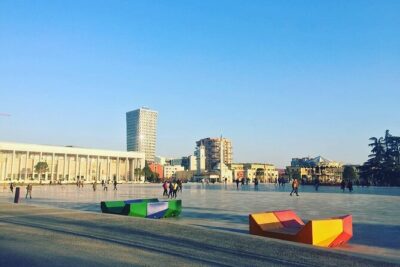

Browse the lists this tour appears in