
Reviewed · WALKING TOURS
Tirana Highlights: A Walking Tour with a Local Guide
Tirana reveals its story one square at a time. This two-hour walk links the capital’s main sights with useful context about Albania’s past, politics, religion, and rapid change. I especially like the local perspective and the efficient route, which gives you a clear first look at central Tirana without taking over your day.
I also like that the tour includes both famous landmarks and places that help explain modern Albania, including Bunk’Art 2, the Prime Minister’s office area, Blloku, and the Pyramid. The main consideration is pace: with around fifteen stops in two hours, several visits are brief, and you should not expect long interior visits or detailed museum time.
The English-speaking guides are the heart of the experience. Ray receives especially warm praise for his humor, clear explanations, and ability to answer questions. Another guide, known as K, brought family stories from the communist period into the wider account of Albania’s recent past. That personal touch can turn a simple walk into a much more meaningful introduction.
In This Review
- Key points to know before you book
- Starting beneath the opera sign
- Skanderbeg Square and the story of the capital
- Et’hem Bey Mosque and Kulla e Sahatit
- Bunk’Art 2 and the memory of communist Albania
- Reja, Tirana Castle, and the city’s changing character
- Mosques, cathedrals, and religious variety
- The Pyramid of Tirana and a city still changing
- Blloku and the final view of modern Tirana
- What the two-hour format does well
- Guide quality and the value of local insight
- Is $23 a fair price?
- Who should book this Tirana walk?
- Should you book it?
- FAQ
- Where does the Tirana walking tour start?
- Where does the tour finish?
- How long is the tour?
- What language is the tour conducted in?
- How much does the tour cost?
- Is the tour wheelchair accessible?
- Which Tirana sights are included?
- Can you cancel for a full refund?
Key points to know before you book
- A compact route through central Tirana: You visit Skanderbeg Square, the mosque, clock tower, Bunk’Art 2, the Pyramid, Blloku, and several cathedrals in about two hours.
- Personal stories add weight: Guides can connect Albania’s communist era and political changes to family and community experiences.
- The tour begins under the opera sign: The Opera and Ballet Theatre is both the meeting point and the return point.
- Expect short stops rather than full admissions: Many locations receive five to ten minutes, so the tour is best for orientation and explanation.
- Good value at $23 per person: The price is modest for a live English-speaking guide covering so many central sights.
- Easy to fit into a busy day: The two-hour length works well for a first morning, an arrival day, or a break between other plans.
Starting beneath the opera sign
Your meeting point is under the sign of the Opera and Ballet Theatre, at the center of Tirana. This is a practical place to begin because the tour quickly moves into the city’s main civic area, rather than spending time on transport.
The route returns to the opera at the end. That makes it simple to continue sightseeing, find lunch, or return to your hotel without having to arrange a ride from a distant neighborhood.
The walk is wheelchair accessible, according to the activity details. Still, the tour involves moving between many locations, so you should be comfortable with a steady walking route and short outdoor stops.
More Walking Tours in Tirana
- Walking Tour of Tirana
★ 5.0 · 646 reviews - Tirana: Express Walking Tour with a Guide
★ 4.8 · 503 reviews - Tirana Center: Magic Walking Tour French/Italian/English Etc
★ 4.9 · 402 reviews
Skanderbeg Square and the story of the capital
The first major section centers on Skanderbeg Square, Tirana’s main public gathering place. It is the right place to begin because so much of the city’s public life comes together here. The guide explains the square’s role in social and political life, helping you see it as more than an open plaza surrounded by landmarks.
You then pause at the Skanderbeg Statue. The statue honors Albania’s national hero and gives the square its name. This is a short stop, but the guide’s explanation helps connect the monument to Albanian identity and national pride.
The National History Museum is included early in the route, with about five minutes set aside. That is enough for an introduction and perhaps a look at the building from outside, but not enough for a proper museum visit. If you want to study Albania’s archaeological, medieval, or communist-era exhibits, plan a separate visit.
This is an important distinction. The walking tour gives you a framework, while the museum can provide the detailed objects and displays later. I like this approach for a first day because you learn what you are looking at before deciding where to spend more time.
Et’hem Bey Mosque and Kulla e Sahatit
The Et’hem Bey Mosque is one of the most important historic buildings on the route. It is presented as a symbol of Tirana’s endurance, and its position beside the central square makes it an essential stop.
The tour allows about five minutes here. That is enough for a brief explanation and an exterior look, but you should not assume that the schedule includes a full interior visit or time for quiet reflection inside. Religious sites may also have their own access rules at the time of your walk.
Nearby, Kulla e Sahatit, or the Clock Tower, gives you another recognizable piece of old Tirana. The short stop helps place the mosque and square within the older center of the city. Again, the value is in the guide’s explanation and the way the landmarks connect, rather than in a long visit to one building.
For many people, this section will be the first point where Tirana’s Ottoman-era, religious, and civic layers begin to make sense. The city’s story is not presented as a single period. You move from national symbols to religious architecture, then toward the institutions and buildings of modern Albania.
Bunk’Art 2 and the memory of communist Albania
Bunk’Art 2 is one of the most striking stops because it points directly to the country’s communist past. The site is associated with the period of state control, fear, and political repression. The tour includes around ten minutes here, giving the guide time to explain why this place matters.
This is also where a strong local guide can make a real difference. K was praised for explaining political and social changes through family and friends who lived through the communist era. That kind of account can make the subject easier to understand without reducing it to a list of dates.
The visit is brief, so you should not expect to explore the full museum in detail. If Albania’s communist period is a main reason for your visit, return later and allow more time. On the walking tour, Bunk’Art 2 works as a powerful introduction and a prompt for further exploration.
Somewhere else in Albania, a completely different day:
- From Tirana: Bovilla Lake & Gamti Mountain Hiking Day Trip
★ 4.9 · 4,397 reviews - From Tirana: Bovilla Lake & Gamti Mountain Hiking Tour
★ 4.9 · 3,003 reviews - From Tirana: Bovilla Lake & Gamti Mountain Viewpoint Hike
★ 4.8 · 2,053 reviews - Tirana/Durres/Golem: Saranda, Ksamil, Blue Eye Day Trip
★ 4.8 · 1,584 reviews
Reja, Tirana Castle, and the city’s changing character
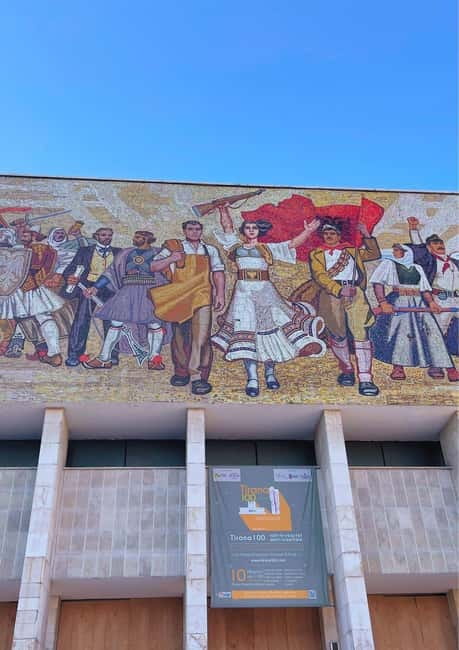
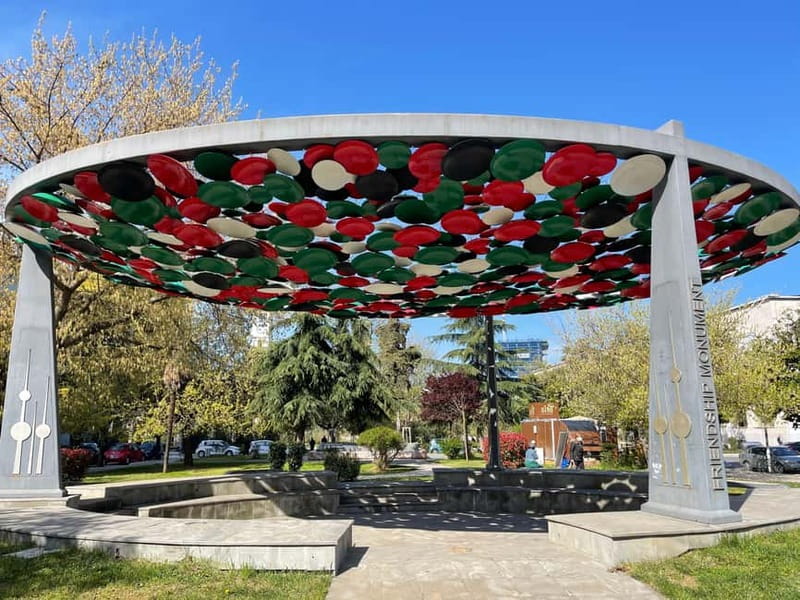
The route continues to Reja, known as The Cloud, a modern art installation that creates a sharp contrast with the older buildings nearby. The five-minute stop shows how Tirana uses public art and new design alongside historic structures.
You then visit Tirana Castle. The name may suggest a grand fortified complex, but the important point for this tour is its place in the modern center and its connection to the city’s older identity. The stop lasts about five minutes, so expect an overview rather than an extended architectural examination.
This stretch is useful because it shows Tirana’s mixed character. You are not simply walking through a preserved old town. You are seeing a capital that has changed quickly, with old religious buildings, communist-era reminders, contemporary art, and redeveloped public spaces all close together.
That mixture can feel untidy at first. The guide helps you read it. Instead of seeing unrelated buildings, you begin to understand the city as a place where different periods remain visible side by side.
Mosques, cathedrals, and religious variety
Namazgah Mosque is another brief stop, followed by Saint Paul Cathedral. The two locations help show the range of religious buildings in central Tirana.
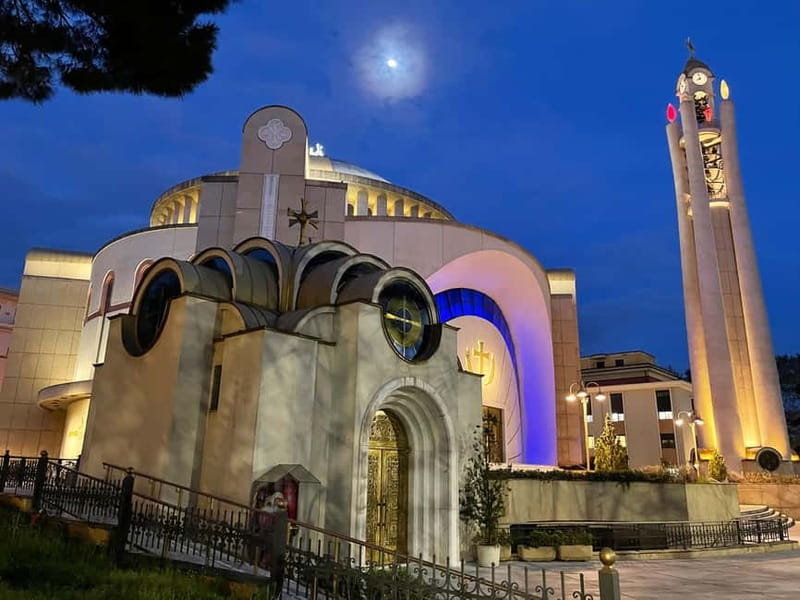
Saint Paul Cathedral represents a more recent style of religious architecture. It gives the route a modern counterpoint to the Et’hem Bey Mosque. The tour does not devote a long period to either site, but together they help explain the city’s religious variety.
The Resurrection of Christ Orthodox Cathedral comes later, with about ten minutes scheduled. This is one of the longer stops and provides more room for the guide to discuss the building and its role in the capital.
Seeing the mosque and cathedrals on the same walk is valuable because it places Albania’s religious traditions in a shared city setting. The tour focuses on observation and explanation, not religious practice, so respectful clothing and behavior remain important when you approach active places of worship.
The Pyramid of Tirana and a city still changing
The Pyramid receives about ten minutes, making it one of the more substantial stops. Its design and past reflect Albania’s complicated communist legacy, while its present role points toward the country’s changing public life.
The building is especially useful for understanding how Tirana handles difficult parts of its past. It is not treated as a simple relic with one meaning. The guide can explain the political story behind it and the way the city has rethought its purpose.
I would pay close attention here if you are interested in architecture or recent history. The Pyramid is one of the places where Albania’s old political system and its newer identity meet in a very visible way.
The stop is still short enough that you may want to return afterward. The walking tour gives you the background, but a separate visit is better if you want photographs, close inspection, or more time around the building.
Blloku and the final view of modern Tirana
The final neighborhood stop is Blloku, with about ten minutes allotted. Blloku is important because it helps explain the social and political changes that shaped modern Tirana. The guide discusses the area as part of the capital’s transformation, rather than treating it only as a place for cafés and nightlife.
This is a good ending because it moves the story from monuments and institutions into everyday city life. You see how Tirana’s public identity has expanded beyond the old central square.
The tour then returns to the Opera and Ballet Theatre after the Orthodox Cathedral. The exact order on the day may feel brisk, but the route gives you a useful map of central Tirana. You will know which places deserve a longer return visit and how the main areas connect on foot.
What the two-hour format does well
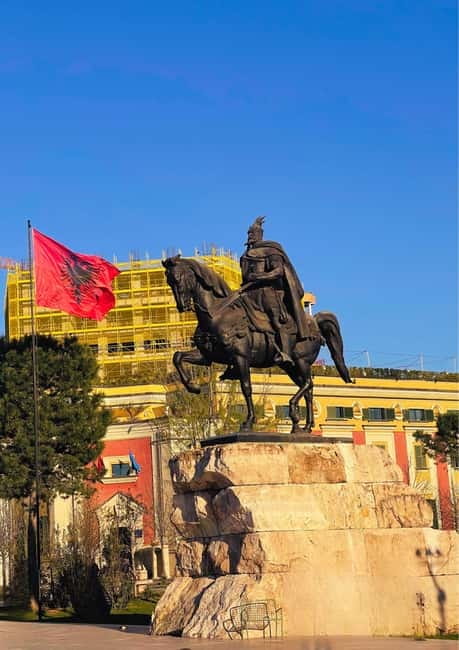
The route includes roughly fifteen named stops, with most receiving five minutes and several receiving ten. That is a lot of ground for a short walk, and the schedule works best as a guided introduction.
I like the balance between major sights and explanation. You see the national statue, mosque, clock tower, museums, religious buildings, public art, the Pyramid, and Blloku in one sitting. You also gain a basic account of communist Albania and the political changes that followed.
The tradeoff is depth. You cannot properly tour the National History Museum, Bunk’Art 2, or the Pyramid in this time. The guide may point out buildings, explain their significance, and answer questions, but you should plan separate visits if you want a full cultural or museum experience.
The short format suits you if you have limited time, want help getting oriented, or prefer to build your own sightseeing plan afterward. It is less suitable if you want a slow photo walk or long visits inside each landmark.
Guide quality and the value of local insight
The clearest strength of this experience is the guide. Ray is praised for keeping the tour informative but fun, while also answering questions with confidence. K is remembered for making Albania’s political and social changes understandable through personal family connections to the communist period.
Those details matter. Tirana’s recent past is not always easy to grasp from architecture alone. A local guide can explain why a building matters, how the city has changed, and how people connect the past to Albania’s present.
The available feedback is very strong, with a 4.9 rating from 16 reviews. Comments also describe the route as well timed, with good distances and useful summaries of the country’s history. One especially practical benefit is that the guide can suggest what to see next and the order in which to do it.
That makes the walk more than a list of photo stops. You leave with a clearer plan for the rest of your time in Tirana.
Is $23 a fair price?
At $23 per person, this is a good-value introduction to Tirana. You are paying for a live English-speaking guide and a route that covers many central landmarks in two hours. For a first visit, the cost is modest compared with the time it could take to understand the same places alone.
The value depends on what you want. If you only need directions and photographs, you can walk around Skanderbeg Square and the nearby sights without paying. If you want the political background, family context, and a sensible route through the center, the guide adds the part that self-guided sightseeing often lacks.
No attraction admissions are listed as included, so do not book this expecting a museum ticket or a long interior tour. Think of the $23 as payment for orientation, interpretation, and local conversation.
You can also reserve now and pay later, and cancellation is free up to 24 hours before the start time. Those terms help if your Albania plans are still shifting.
Who should book this Tirana walk?
I would recommend it to first-time visitors, short-stay visitors, and anyone who wants to understand Tirana before exploring alone. It is also a good choice for people who enjoy history but prefer explanations in plain language rather than a formal lecture.
The tour suits you especially well if you want to learn about the communist period, see the main central landmarks, and hear how Albania has changed through local experience. Ray’s humor and K’s family-based perspective suggest that the strongest moments come from conversation as much as from the buildings.
You may want something else if you dislike brisk walking or want lengthy museum visits. The tour is wheelchair accessible, but its many stops and steady movement still make the pace worth considering.
Should you book it?
Book this tour if you want a clear first map of Tirana and a guide who can explain more than the names of the monuments. At $23, it offers strong value for two hours, especially when you are new to the city or short on time.
Skip it only if you already know central Tirana well or prefer to spend your time inside museums and religious buildings. For most first visits, the route gives you the right foundation, then leaves the rest of the day open for returning to the places that caught your attention.
FAQ
Where does the Tirana walking tour start?
The tour starts under the opera sign at the Opera and Ballet Theatre in Tirana.
Where does the tour finish?
The walk returns to the Opera and Ballet Theatre.
How long is the tour?
The tour lasts two hours.
What language is the tour conducted in?
The live tour guide speaks English.
How much does the tour cost?
The listed price is $23 per person.
Is the tour wheelchair accessible?
Yes, the activity is listed as wheelchair accessible.
Which Tirana sights are included?
The route includes the National History Museum, Skanderbeg Square, the Skanderbeg Statue, Et’hem Bey Mosque, Kulla e Sahatit, Bunk’Art 2, Reja, Tirana Castle, Namazgah Mosque, Saint Paul Cathedral, the Pyramid of Tirana, Blloku, and the Resurrection of Christ Orthodox Cathedral.
Can you cancel for a full refund?
Yes. You can cancel up to 24 hours in advance for a full refund.
Newly listed around Tirana
- Wonderful Sunset and Dinner in the Castel Of Petrela★ 4.6 · 4 reviews
- Zipline Tirana Adventure & Petrela Castle – With Transport★ 4.4 · 10 reviews
- Wine Tasting & Vineyards Escape near Tirana★ 4.9 · 8 reviews
- Walking Tour in Tirana, Albania★ 3.7 · 28 reviews
- Vlora, Dhermi & Llogara Day Trip from Durrës or Golem★ 5.0 · 5 reviews
- Day Tour to Petrela Castle and Zip Line Albania Adventure★ 5.0 · 10 reviews
- From Tirana: Mount Dajti Adventure, Local Vibes & Cable Car opt★ 4.5 · 6 reviews
- Winetasting tour in Alpeta winery – Roshnik village by 1001 Albanian Adventures★ 5.0 · 26 reviews
Walking Tours, compared.
Tirana Center: Magic Walking Tour French/Italian/English Etc
Read our review →
Blue Eye Kayak and walking tour & Lekursi Castle
Read our review →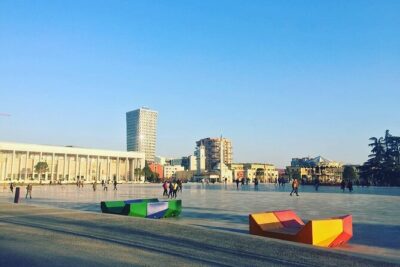

Browse the lists this tour appears in