Reviewed · TIRANA TOURS
GUIDED TOUR OF TIRANA
Tirana tells its story in layers. This 150-minute walking tour links Albania’s national hero, Ottoman-era landmarks, communist monuments, lively markets, and modern café culture in one well-paced introduction. I like the way it moves beyond the main square, especially to Pazari i Ri and the former political quarter of Blloku.
I also like the focus on explanation rather than simple sightseeing. Guides such as Dorina and Renato have been praised for answering questions, adding amusing anecdotes, and explaining Albania’s changing political regimes in clear French. The main consideration is time: two and a half hours gives you a useful overview, but stops such as the market, Pyramid, and Blloku are brief rather than full visits.
In This Review
- Key points to know before booking
- Why this Tirana tour works as a first look
- Skanderbeg Square and Albania’s national story
- From the Dajti Hotel to Rinia Park
- The Lana River bridge and Tirana’s changing image
- The Pyramid and the memory of Enver Hoxha
- Pazari i Ri, where the city becomes practical and local
- Blloku, from restricted quarter to social center
- The guides make the difference
- Price, pace, and practical fit
- Who should book the Tirana city tour?
- Final verdict: a useful, fairly priced introduction
- FAQ
- How long does the Guided Tour of Tirana last?
- How much does the tour cost?
- Which languages are available?
- Can I cancel the tour for a full refund?
- Is the tour wheelchair accessible?
- Is the tour suitable for people with hearing impairments?
Key points to know before booking
- Skanderbeg Square sets the scene: Learn how Tirana’s central square connects Albania’s national story with Ottoman, communist, and modern architecture.
- The guide is the main strength: Dorina and Renato have earned praise for thoughtful explanations, questions answered patiently, and history presented in an approachable way.
- The Pyramid gives the tour historical weight: This former mausoleum to Enver Hoxha now serves as a computer training center, a striking example of changing public memory.
- Pazari i Ri adds everyday Albania: Fruit, vegetables, honey, olive oil, and other local goods make this more than a monument-to-monument walk.
- Blloku shows modern Tirana: The former political elite’s quarter is now known for cafés, colorful buildings, and painted electrical boxes.
- The format is practical: The tour lasts 150 minutes, costs $23 per person, offers English, French, and Spanish, and is wheelchair accessible.
Why this Tirana tour works as a first look
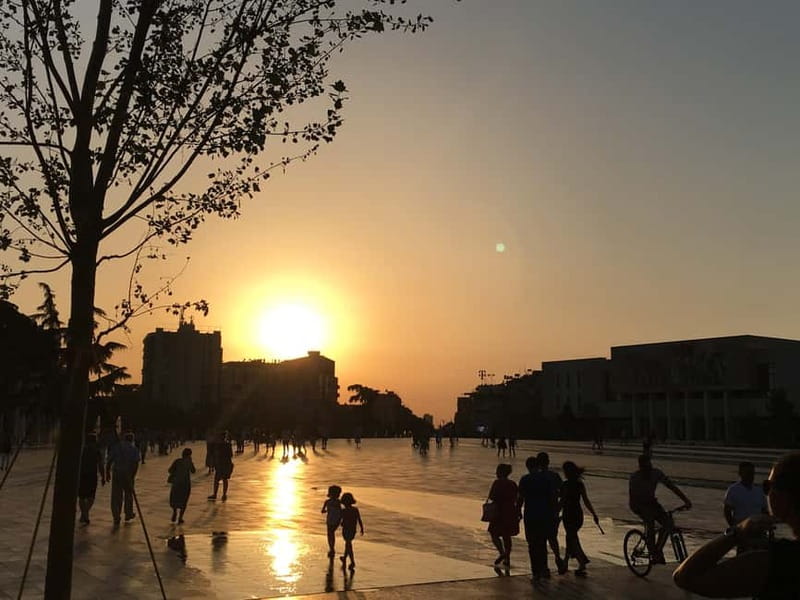
Tirana can feel hard to read at first. Its broad central square, Ottoman mosque, communist-era buildings, bright façades, new construction, and café districts do not always explain themselves. A local guide helps connect those pieces.
For $23 per person, you receive a 150-minute guided introduction rather than a long list of disconnected sights. I consider that good value if you want context quickly, especially at the start of an Albanian trip. You can then decide which places deserve a longer return visit.
The tour also gives you a useful mix of public monuments and ordinary city life. Skanderbeg Square provides the formal history lesson. Pazari i Ri shows how people shop and meet today. Blloku shifts the mood again, with bars, cafés, street art, and colorful urban details.
The experience is not designed for deep interior visits or extended museum time. The emphasis is on seeing the city on foot and understanding how its past still shapes daily life. That makes it a good choice for a first day in Tirana, provided you are comfortable with a fairly active city walk.
A few more Tirana trips worth comparing
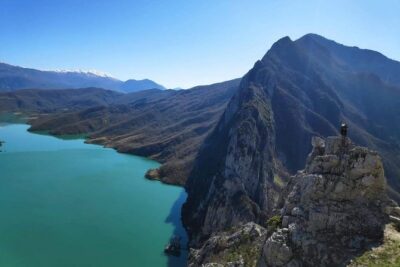
- From Tirana: Bovilla Lake & Gamti Mountain Hiking Day Trip
★ 4.9 · 4,397 reviews - From Tirana: Bovilla Lake & Gamti Mountain Hiking Tour
★ 4.9 · 3,003 reviews - From Tirana: Bovilla Lake & Gamti Mountain Viewpoint Hike
★ 4.8 · 2,053 reviews
Skanderbeg Square and Albania’s national story
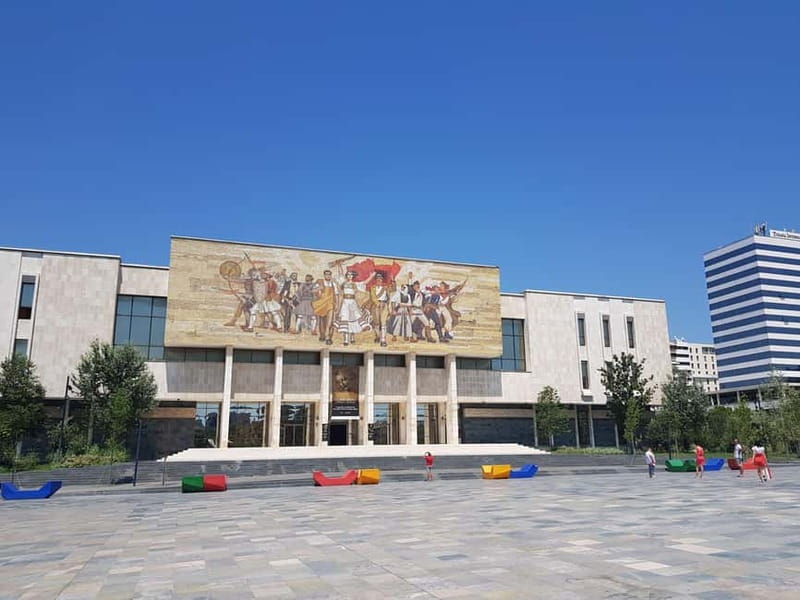
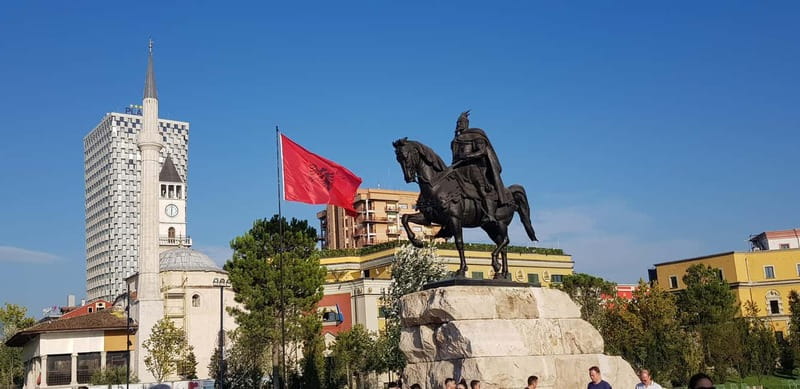
The tour begins at Skanderbeg Square, the symbolic center of Tirana. At its heart is the equestrian statue of Gjergj Kastrioti Skënderbej, better known as Skanderbeg, Albania’s national hero.
Skanderbeg led resistance against Ottoman occupation in the 15th century. His statue gives the square a clear national focus, and the guide uses it to explain why this figure remains so important to Albanian identity.
The square itself is worth studying as a group of buildings rather than one isolated sight. Around it, you will hear about the Et’hem Bey Mosque, the Clock Tower, the Palace of Culture, the National Museum, the Central Bank, and several ministry buildings.
This is where a guide adds real value. Without context, the square can look like a collection of grand façades from different periods. With an explanation, you can begin to see the changes in power, religion, architecture, and national identity written across the city center.
The Et’hem Bey Mosque and Clock Tower are especially useful reference points. Together, they point to an older Tirana, while the Palace of Culture and government buildings reflect later political priorities. The National Museum adds another layer to the city’s public version of Albanian history.
I would pay close attention here, since this opening section gives you the vocabulary for the rest of the walk. The guide’s explanation of the square helps you understand why Tirana looks so different from one block to the next.
From the Dajti Hotel to Rinia Park
After Skanderbeg Square, the route continues toward the Dajti Hotel, the Fine Arts Gallery, and Rinia Park. These stops broaden the tour beyond the formal center and show how public spaces and institutions fit into modern Tirana.
The Fine Arts Gallery brings culture into the route without turning the experience into a museum tour. You should not expect a long gallery visit based on the available details, but its inclusion helps show that Tirana’s cultural life is not limited to its national museum or historic mosque.
Rinia Park offers a change of pace. After the concentration of monuments and government buildings, a park gives you a more relaxed view of the city. It also helps explain how Tirana’s central area works as a place for both official business and everyday leisure.
The route is practical because these stops connect naturally by walking. No transport is listed, so you should plan on moving through the city on foot. Wear comfortable shoes and allow yourself enough room to keep up with the group while listening.
The Lana River bridge and Tirana’s changing image
The Lana River bridge is used as a photo stop before the tour reaches the Pyramid. This is a short pause, but it gives you a chance to look at Tirana from a different angle and take a few city photographs.
Do not expect a long riverside visit. The bridge is included as a visual break in the route, not as a major sightseeing destination. Its value comes from the change in viewpoint and the transition it creates between the central monuments and the city’s most recognizable communist-era structure.
That changing image is one of the tour’s strongest themes. Tirana is not presented as a preserved old town. It is a city that has repeatedly changed its public face, sometimes by choice and sometimes through political upheaval.
Somewhere else in Albania, a completely different day:
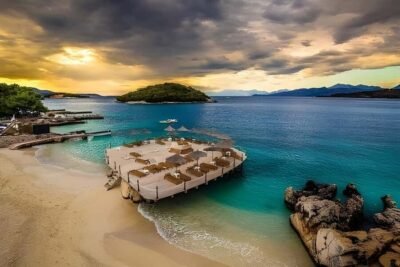
- Tirana/Durres/Golem: Saranda, Ksamil, Blue Eye Day Trip
★ 4.8 · 1,584 reviews - Hike Gamti Mountain with Bovilla lake view & canyon- From Tirana
★ 5.0 · 1,280 reviews - Tirana: 2 Hour Guided Hidden Treasures Sightseeing Tour
★ 4.8 · 948 reviews - Berat city UNESCO tour, the Castle & Belshi lake- From Tirana
★ 5.0 · 804 reviews
The Pyramid and the memory of Enver Hoxha
The Pyramid is one of the most striking stops on the route. It was erected in 1988 as a mausoleum for Enver Hoxha, Albania’s communist leader. Today, it serves as a computer training center.
That simple change in use tells you a great deal about Albania. A building created to honor a former leader now has a practical, modern purpose. The Pyramid is not just an unusual piece of architecture. It is a reminder that public buildings can outlive the ideas they were built to promote.
The guide’s explanation is particularly useful here because Albania’s communist period can be difficult to understand from a quick visit. The tour helps place the Pyramid within the country’s wider political story, including the shift between different regimes.
You may find the stop more interesting from the outside than as a formal interior visit. The available details describe the building and its present function, but not an extended entrance or guided visit inside. Treat it as an important exterior landmark and a chance to ask questions.
Several reviews praise the guides for explaining complex history in a way that is easy to follow. That matters most at the Pyramid, where a short, clear explanation can make the building far more meaningful.
Pazari i Ri, where the city becomes practical and local
Pazari i Ri is one of the most enjoyable parts of the route because it shifts from political history to daily life. This colorful central market district is built around a modern hall of glass and steel.
Inside, traders sell fruit, vegetables, honey, olive oil, and other goods. The market gives you a chance to see the practical side of Tirana, where food shopping, conversation, and local commerce share the same space.
I like this stop because it keeps the tour from becoming too formal. Monuments can explain a country’s public story, but a market shows what people buy, sell, and value in ordinary life. Even a short walk through the district can add texture to your understanding of the city.
The market is also a useful place to revisit later. The tour does not promise an extended shopping session or a food tasting, so you should not expect those extras. If you spot something you want to buy, note the location and return with more time after the guided walk.
Pazari i Ri works best when you slow your eyes down. Look at the produce, the market hall, and the way the district combines older commercial habits with newer urban design. It is a small but useful counterpoint to the monumental buildings around Skanderbeg Square.
Blloku, from restricted quarter to social center
The final suggested area is Blloku, one of Tirana’s best examples of political change made visible in an urban neighborhood. During the communist period, it was reserved for the political elite. Today, it is known as one of the city’s trendiest districts.
That contrast gives the area more meaning than a simple café stop. Blloku shows how a place once associated with exclusion can become a public social quarter. The tour connects the neighborhood’s past with its current bars, cafés, and colorful streets.
Keep an eye on the electrical boxes. They are systematically covered with paintings, creating small bits of street art across the district. You will also see colorful buildings, which add a lighter and more playful feel after the serious history of the Pyramid.
The tour suggests that you can enjoy a drink here and experience a typical Albanian bar atmosphere. That is a useful ending because it leaves you in a place where you can continue exploring on your own.
The guided portion may not include an extended café stay. Think of Blloku as the final neighborhood orientation, with the option to stop for a drink afterward. If you want to understand Tirana’s evening scene, this is a practical place to begin.
The guides make the difference
The strongest praise is directed at the guides. Dorina is described as gentle, friendly, and able to answer every question. Her explanations connect the city’s sights with the life of the country and its different political regimes.
Renato is praised for adapting to a small group, adding detail about Albanian history and culture, and using amusing anecdotes to keep the material lively. That ability to adjust matters because a good city tour should respond to the group rather than deliver a rigid speech.
One French-language review describes the guide as passionate about history, art, and Albania, with excellent French. Another praises the way a complicated history becomes easy to listen to. These are important qualities for a tour covering Skanderbeg, Ottoman influence, communism, and modern Tirana in only 150 minutes.
Live guiding is available in French, English, and Spanish. The included guide is listed as English or French speaking, while the activity details also name Spanish. If your language is important, confirm the available guide language when you check the starting time.
Price, pace, and practical fit
At $23 per person, the tour is priced for accessibility rather than luxury. You are paying for a local explanation and a structured route through several key districts, not private transport, a meal, or a long series of interior admissions.
I see the best value in the guide’s ability to connect the stops. You could walk around Skanderbeg Square, the Pyramid, Pazari i Ri, and Blloku on your own, but you would likely miss some of the political and cultural links between them.
The 150-minute duration is long enough to build a useful mental map without taking up your whole day. It is also short enough to fit before another activity, a museum visit, or an evening in Blloku.
The tradeoff is limited time at each location. If you want to shop at the market, spend a long time photographing the Pyramid, or sit down for a drink in Blloku, plan to return after the tour.
The tour is wheelchair accessible, which is helpful for visitors who need that feature. It is not suitable for people with hearing impairments, so anyone relying on hearing support should consider that limitation carefully.
Free cancellation is available up to 24 hours before the activity for a full refund. You can also reserve now and pay later, which gives you some flexibility when planning a changing Albania itinerary.
Who should book the Tirana city tour?
I would choose this tour if you want a clear introduction to Tirana’s main sights and the forces that shaped the city. It suits first-time visitors, history-minded people, and anyone who prefers a local explanation to reading plaques alone.
It is also a good fit if you enjoy seeing both formal landmarks and ordinary places. The mix of Skanderbeg Square, Rinia Park, the market, and Blloku gives you more than a standard central-city monument walk.
You may want something else if you prefer long museum visits, food-focused tours, or a private itinerary built around your own interests. The route covers many subjects, so it provides breadth rather than extended time at one site.
Final verdict: a useful, fairly priced introduction
Book this guided tour if you want Tirana to make sense quickly. For $23, you get a well-chosen route through national history, Ottoman heritage, communist memory, local shopping, and modern café life.
The best reason to go is the guide. Dorina and Renato are praised for warmth, patience, clear language, detail, and humor, all of which matter when Albania’s past becomes politically complex. Just remember that the tour is an overview. Use it to get your bearings, ask questions, and mark the places you want to explore more slowly afterward.
FAQ
How long does the Guided Tour of Tirana last?
The tour lasts 150 minutes, or two and a half hours.
How much does the tour cost?
The price is $23 per person.
Which languages are available?
Live guides are available in French, English, and Spanish. The included guide is listed as English or French speaking, so confirm the language when checking availability.
Can I cancel the tour for a full refund?
Yes. You can cancel up to 24 hours in advance for a full refund.
Is the tour wheelchair accessible?
Yes, the activity is wheelchair accessible.
Is the tour suitable for people with hearing impairments?
No. The activity is listed as not suitable for people with hearing impairments.
Newly listed around Tirana
- Wonderful Sunset and Dinner in the Castel Of Petrela★ 4.6 · 4 reviews
- Zipline Tirana Adventure & Petrela Castle – With Transport★ 4.4 · 10 reviews
- Wine Tasting & Vineyards Escape near Tirana★ 4.9 · 8 reviews
- Walking Tour in Tirana, Albania★ 3.7 · 28 reviews
- Vlora, Dhermi & Llogara Day Trip from Durrës or Golem★ 5.0 · 5 reviews
- Day Tour to Petrela Castle and Zip Line Albania Adventure★ 5.0 · 10 reviews
- From Tirana: Mount Dajti Adventure, Local Vibes & Cable Car opt★ 4.5 · 6 reviews
- Winetasting tour in Alpeta winery – Roshnik village by 1001 Albanian Adventures★ 5.0 · 26 reviews
Tirana Tours, compared.
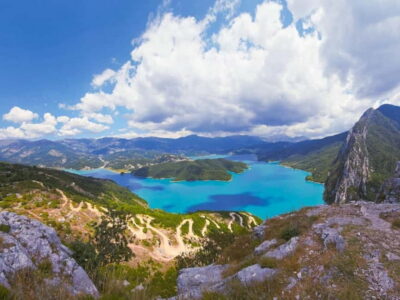
Bovilla Lake & Gamti Mountain Hiking Day Trip
Read our review →
Hike Gamti Mountain with Bovilla lake view & canyon- From Tirana
Read our review →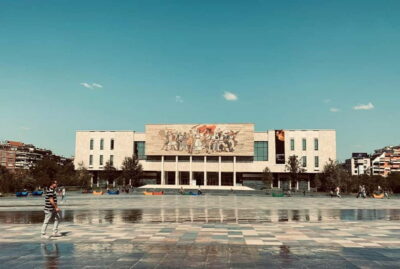
2 Hour Guided Hidden Treasures Sightseeing Tour
Read our review →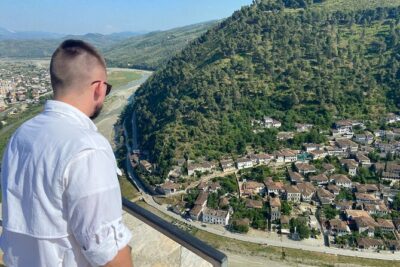
Berat city UNESCO tour, the Castle & Belshi lake- From Tirana
Read our review →